
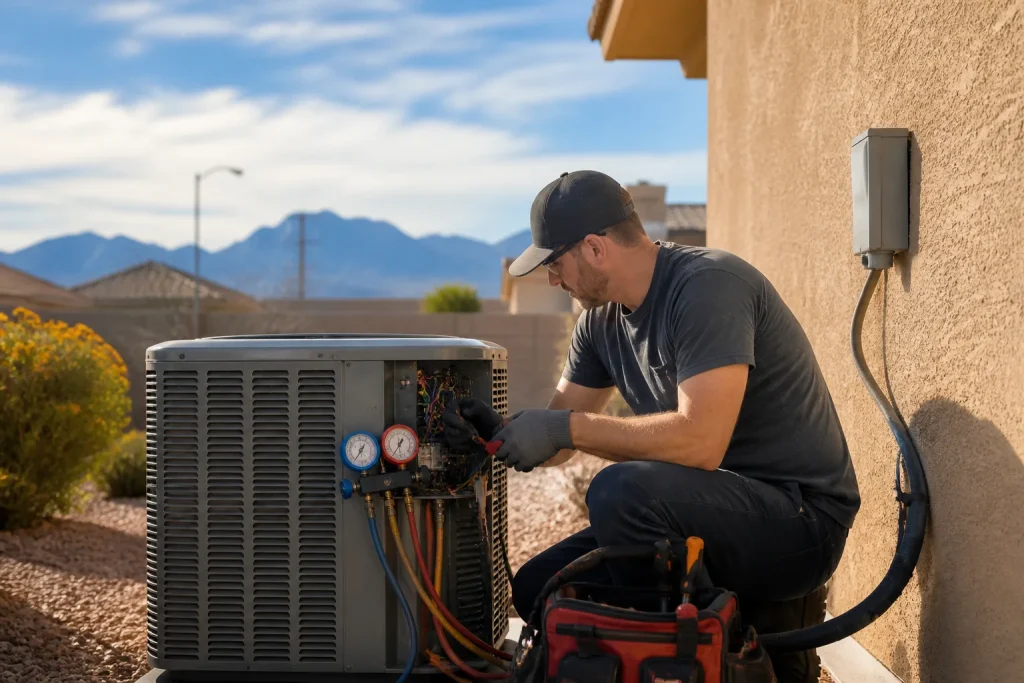
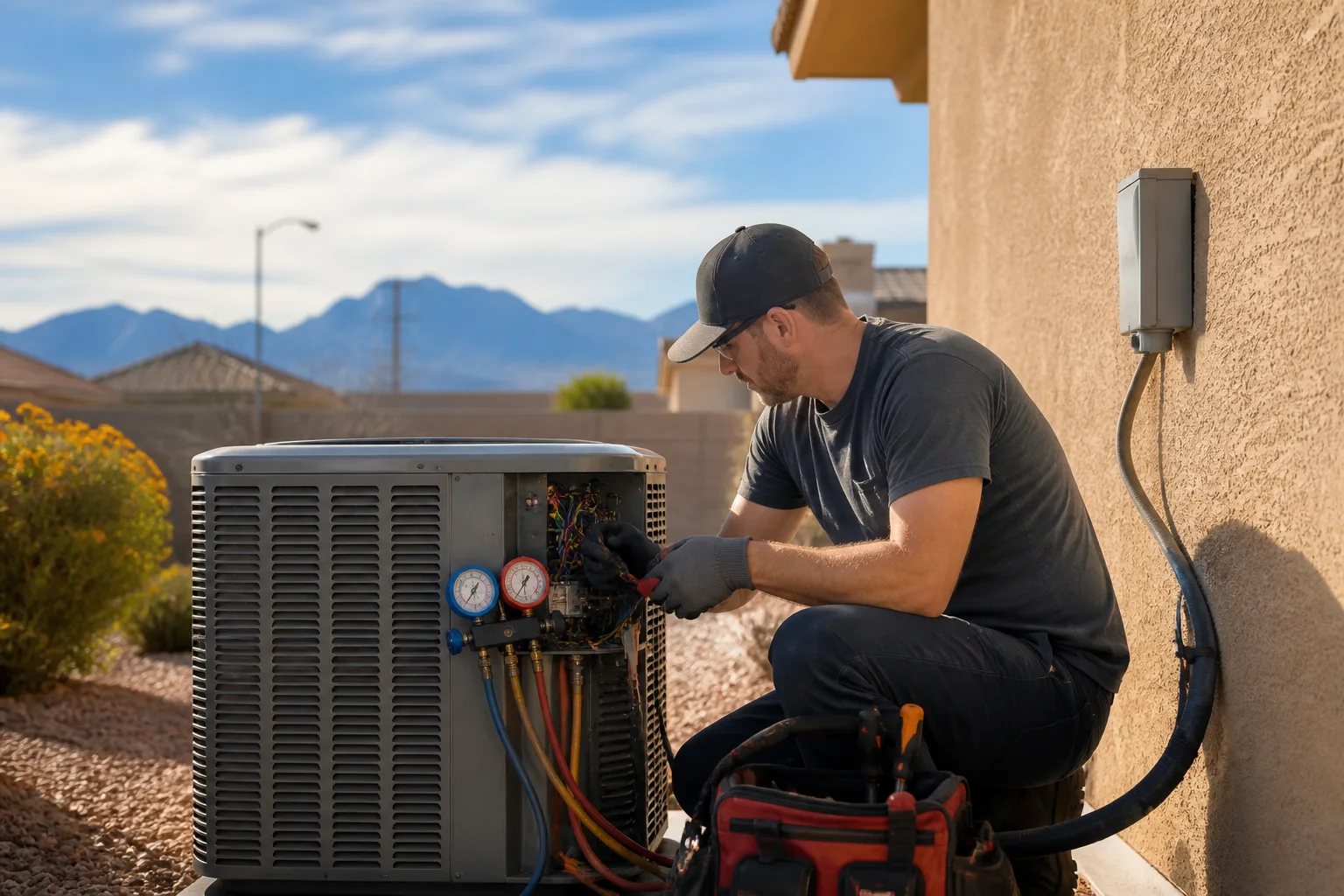
Top Signs You Need HVAC Service – Don’t Ignore These
The number one sign Sunrise Manor homeowners miss isn’t a noise or a smell. It’s the system running 20 minutes longer per cycle than it did last summer. That runtime creep is the system telling you something is wrong long before anything dramatic happens. In Sunrise Manor’s summer heat, catching that early signal is often the difference between a $200 repair and a $2,400 compressor replacement.
Most “warning signs” lists you’ll find online give you the late-stage signals: strange noises, warm air, high bills. Those are real, but by the time you notice them, the damage is often well underway. Here’s the same information reordered by when the signs actually show up in the failure sequence, so you can act early instead of paying for it later.
If you’d rather not spend a Saturday afternoon playing detective with your system, call (877) 311-5951. We’ll take a look and tell you straight what’s going on.
1. The Runtime Creep: The Early Sign Almost Everyone Misses
Before you ever hear a strange noise, the system starts working harder to do the same job. Your AC used to cool the house in a certain number of minutes. Then it started taking a little longer. Then a little longer. Homeowners blame the thermostat, the weather, or their own imagination. It’s none of those things.
Here’s how to establish a baseline that actually means something:
- Pick a normal day. Mid-80s outside, house thermostat at its usual setting. Time the full cycle: from when the condenser kicks on to when it shuts off.
- Write it down. Put the number on the fridge. You’ll want it next month.
- Time it again in 30 days, same conditions. A 15 – 20% increase in runtime is the number that matters. A cycle that used to run 30 minutes now running 36 to 40 minutes per cycle is your system asking for help.
Mechanically, that creep usually means one of a few things: a refrigerant charge that’s drifting low, a dirty condenser coil working against the compressor, or a failing capacitor that’s pulling more amps to start. In Sunrise Manor, where summer days regularly push past 105°F, we see all three show up in June and July. Each one is a few-hundred-dollar fix if caught early and a compressor replacement if ignored through August.
2. Humidity Discomfort Before Warm Air: The Refrigerant Signal Nobody Reads
A slightly undercharged system doesn’t usually blow warm air first. It blows air that’s a little clammy. The house feels sticky, not hot. Homeowners reach for the thermostat, drop it two degrees, and the discomfort doesn’t go away. Then they call us and say “my AC isn’t cooling like it used to.”
What’s actually happening is this: the refrigerant charge is low enough that the evaporator coil isn’t getting cold enough to pull moisture out of the air the way it should. Temperature feels roughly fine. Humidity climbs. That clammy feeling is the refrigerant system telling you it’s low before it ever tells you it’s failed.
Why this matters in Sunrise Manor specifically: the monsoon season pushes humidity through the valley in late summer, and a system that was “fine” in June shows its weakness in August. If your house feels muggy while your neighbor’s feels crisp, and both houses are set to the same temperature, that’s not a thermostat problem. That’s a charge or airflow problem, and it’s worth a set of gauge readings to know which.
Readings first, numbers second. We test the system’s actual pressures and temperatures before anyone says the word repair. If you’re in Sunrise Manor and want that kind of honest look, AC Repair & Installation in Sunrise Manor is where we start.
3. Smells Tell Two Completely Different Stories
Not all smells are created equal. Here’s the split, because the urgency level is completely different:
- An electrical, burning-plastic, or hot-wire smell means something in the electrical circuit is failing: a contactor, a capacitor, a burnt wire, a failing motor winding. This is the emergency-tier smell. Turn the system off at the thermostat and call. Don’t run it to “see if it clears up.” It won’t.
- A musty, damp, or dirty-sock smell is a mechanical and air-quality issue: a wet evaporator coil, a clogged drain pan, mold growth on the coil or in the ductwork. It’s not an electrical hazard, but it means moisture is sitting somewhere it shouldn’t be. Slow down, call when you can, but it’s usually not a “shut it off tonight” situation.
We pulled a unit out of a garage in Sunrise Manor last August where a homeowner had been running the system for three weeks with a burnt contactor because “the smell went away in the mornings.” It hadn’t gone away. It had melted into the wire nut. That’s a $60 part that turned into a $400 repair because nobody shut it off.
Two rules and you’re covered: one smell means stop, the other means schedule.
4. Ice on the Coil: Refrigerant, Airflow, or Both?
Ice on the indoor coil or on the big copper line outside is one of the most misdiagnosed failures we see in Sunrise Manor. Homeowners see ice, assume “it just needs more Freon,” and add refrigerant on top of a problem that was never about refrigerant.
Ice means the coil got below freezing, and that happens for one of three reasons:
- Low refrigerant charge. The pressure drops, the coil temperature drops below 32°F, and condensation freezes on the coil. This is the case many homeowners assume.
- Restricted airflow. A clogged filter, a failing blower, or closed or blocked registers. Not enough air moves across the coil, the coil gets too cold, and it freezes. This is more common than most people realize.
- Both at once. And this is why adding refrigerant to a frozen system without checking airflow is how a $150 fix turns into a compressor replacement.
Here’s the safe check, not the fix: turn the system off at the thermostat. Let the ice melt. Change the filter if it’s dirty. If it freezes again within 24 hours, stop and call. Do not attempt to add refrigerant yourself; the pressures and temperatures involved, and the EPA handling rules, make that a job for someone with gauges and a license.
If your system is iced up now, Heat Pump & Mini Split in Sunrise Manor walks through how we diagnose the airflow-versus-charge question on both systems.
5. The One Sign That Means Stop, and the Ones That Mean Call Soon
Most warning signs give you a day or two to schedule. One doesn’t. Here’s the split:
Shut it off right now, don’t run it again:
- An electrical or burning smell of any kind.
- Repeated breaker trips when the system starts.
- Any buzzing or humming coming from the outdoor unit that doesn’t stop when the system cycles off.
- Visible sparks, scorch marks, or melted wiring at the disconnect box.
These are electrical failure signals. Continuing to run the system risks a fire or a motor burn-out, and no repair is worth that risk.
Call soon, but running it overnight won’t hurt:
- Runtime creep.
- Clammy air or rising humidity.
- A musty smell.
- Ice on the coil, once you’ve shut it off to thaw and it hasn’t refrozen within hours.
- One degree of warm air at the registers.
The middle path here is what saves Sunrise Manor homeowners the most money. Those “call soon” signs are the ones that turn into “shut it off” emergencies if you wait three weeks.
When to Call a Pro Instead of Waiting
If you’ve timed a cycle and found that 15 – 20% runtime increase, or your house feels clammy while the thermostat says 75, or the outdoor unit has started buzzing, that’s the point where a set of gauge readings is cheaper than a repair down the road. A trained call is a few hundred dollars. A compressor replacement is thousands. Our technicians have up to 24 years of experience on Sunrise Manor systems, and we’re happy to give you a free second opinion on any written estimate from another company before you commit.
We also want to flag one more signal that doesn’t get talked about enough: your furnace or heat pump is the same system, and if you’re seeing any of these signs in cooling season, they often show up in heating season too. The Heating & Furnace in Sunrise Manor page covers the heating-side versions of the same failure patterns.
If your system is due for a look either way, we’re licensed, insured, and background-checked on every visit. No trip charge inside the county. If you want to start with a baseline, Ray’s Heating & Air Sunrise Manor home is a good place to look up what we cover.
The Bottom Line
The signs everyone lists online (noises, warm air, high bills) are the late-stage signals. The early signals are runtime creep, humidity discomfort, and smells that don’t quite match “it’s just running hot out.” Catching the early ones in Sunrise Manor’s summer heat is the difference between a $200 repair and a $2,400 compressor replacement. Your thermostat tells you the temperature. Your system tells you what’s wrong. Listen first.
If you’re in Sunrise Manor and need help, Ray’s Heating & Air Sunrise Manor offers free estimates, live phone answers 24/7, and no trip charge inside the county. Call (877) 311-5951.
Frequently Asked Questions
If the circuit breaker trips repeatedly, you smell burning plastic, or the outdoor unit is buzzing when it should be quiet, shut the system off at the thermostat and call. Those are electrical failure signals. If your house feels clammy or the cycle time has crept up, schedule a visit within days, not weeks.
Most common repairs, a capacitor, a contactor, a refrigerant top-off after a leak repair, run a few hundred dollars. A compressor replacement runs into the low thousands. The best way to know which you’re facing is a set of gauge and meter readings, usually before any work begins. Call (877) 311-5951 for an exact quote on your system; estimates are free.
Runtime creep with little temperature improvement usually points to a refrigerant charge that’s drifting low, a dirty condenser coil, or a failing capacitor. Run the runtime test at the top of this article and compare to last month. If it’s up 15% or more, it’s worth a set of readings before hot weather pushes the system harder.
If your only signs are runtime creep, clammy air, or a musty smell, run it overnight and call in the morning. If you smell anything electrical, hear buzzing from the outdoor unit, or the breaker has tripped more than once, shut it off and don’t turn it back on until someone looks at it. Running a system with an electrical fault overnight is a fire risk, not a comfort issue.
Written by the team at Ray’s Heating & Air Sunrise Manor.
Need HVAC Help?
Call Ray's Heating & Air Sunrise Manor - licensed & insured, here with fast after-hours help in Sunrise Manor.
(877) 311-5951