
Emergency AC Repair & Installation Near Me: What Sunrise Manor Homeowners Should Do First
When an AC dies at 9 p.m. in July in Sunrise Manor, the indoor temperature hits 95°F in roughly four hours in a typical tract home. That timeline isn’t a scare tactic – it’s what decides whether you’re making phone calls or packing a bag to a relative’s house. The thirty minutes between “the AC just quit” and “someone’s on the way” are the ones that matter. Here’s the sequence most homeowners skip entirely.
If you’d rather not run the checklist yourself, call us at (877) 311-5951. A live person answers around the clock.
Run the 10-Minute Triage Checklist Before You Call Anyone
About 15% of the “emergency” AC calls we take in Sunrise Manor turn out to be something a homeowner could have fixed in under ten minutes – or something that should never have been a service call at all. Before you dial, work through this list in order. It’s the same one we’d run standing in your hallway.
- Check the thermostat setting and batteries. Sounds obvious. We’ve driven to homes where a thermostat had been knocked into “heat” mode, or the batteries in a smart thermostat had died mid-July. If the screen is blank, swap the batteries and try again.
- Look at the breaker panel. The indoor air handler and the outdoor condenser often sit on separate breakers. A tripped breaker on the condenser is common on Sunrise Manor’s older tract homes after a heavy monsoon-season electrical storm. Flip it fully off, then back on, once.
- Check the air filter. A filter choked with dust cuts airflow and can freeze the indoor coil. Replace it or pull it out and run the system without one for a few minutes to see if air moves.
- Look for water around the indoor unit. A clogged condensate drain triggers a float switch that shuts the system off as a safety measure. If you see water pooling, that’s likely your culprit.
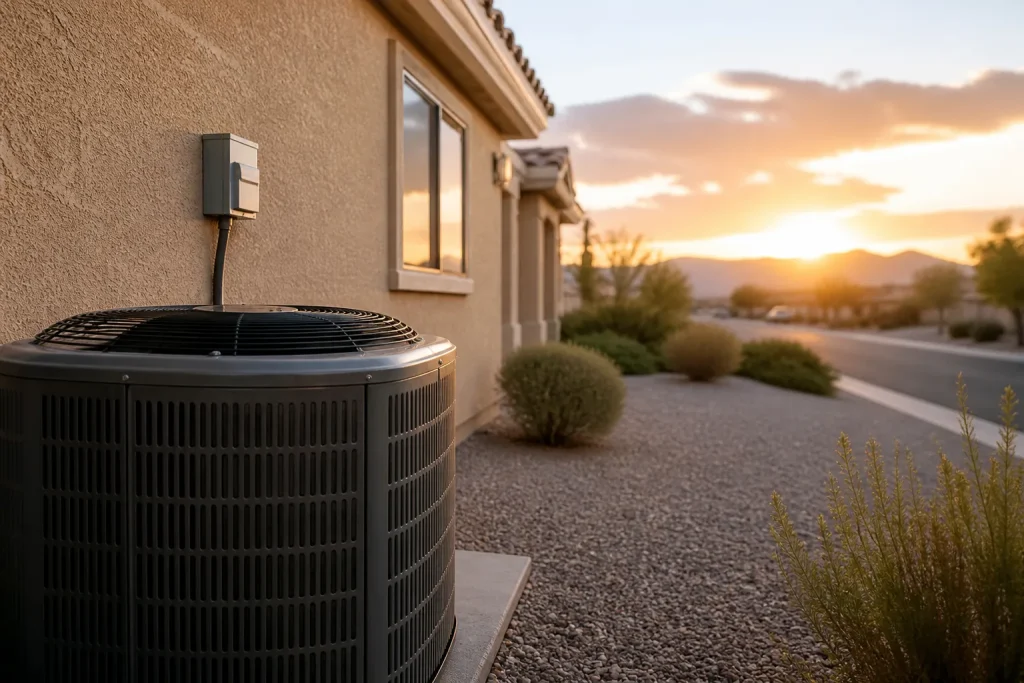
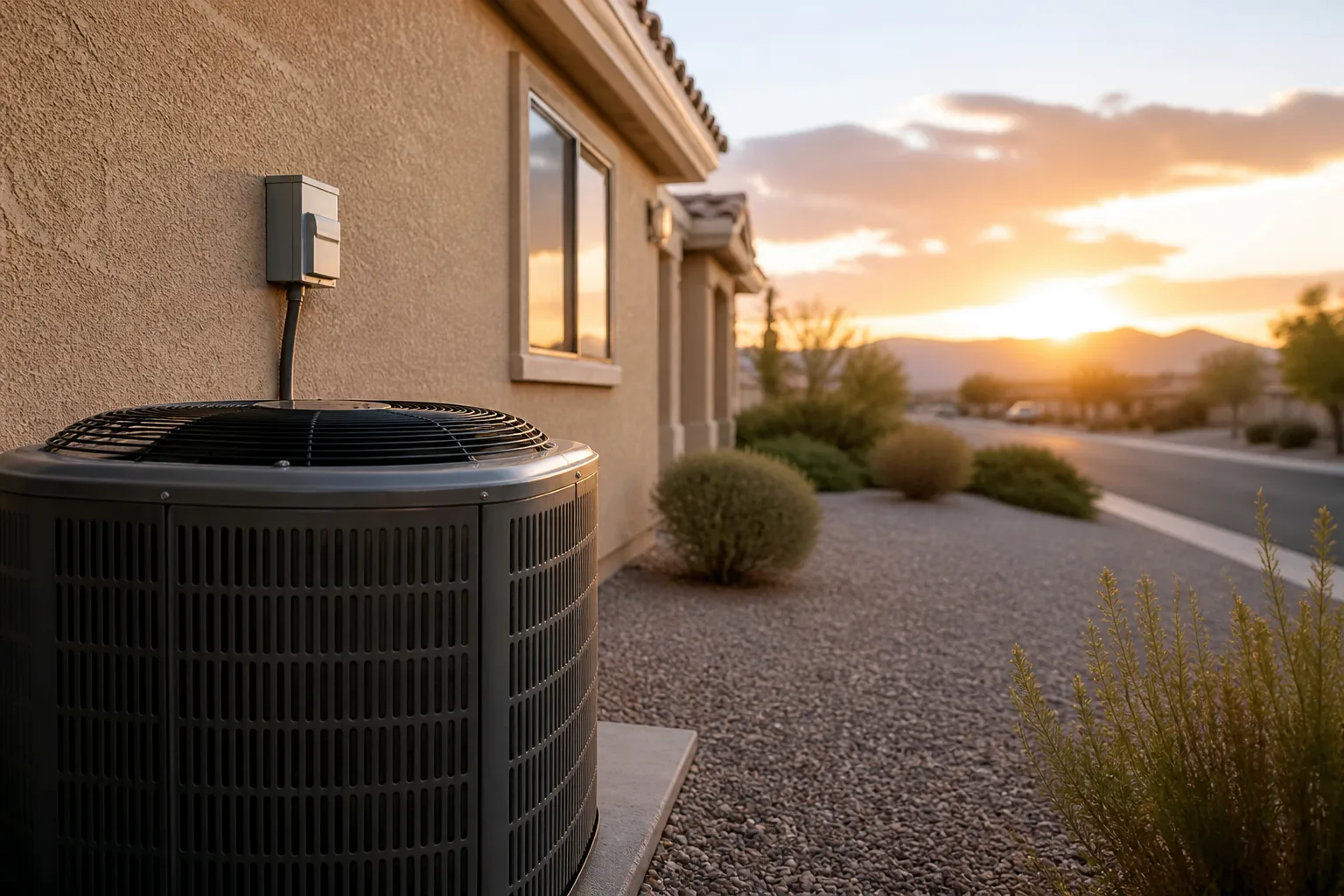
- Go outside and listen to the condenser. Is the fan spinning? Is the compressor humming or silent? Is there ice on the refrigerant lines?
- Check the outdoor disconnect. Some homes have a pull-out disconnect box near the condenser. Make sure it’s seated.
If none of that gets cold air moving, you have a real problem. Now the phone call matters.
Is It a Real Mechanical Failure or a Safety Shutoff?
Most AC “failures” fall into two buckets: the system is genuinely broken, or it shut itself off on purpose. Knowing which one you have changes what you ask the person on the phone and how quickly you need someone at the door.
A safety shutoff is the system protecting itself. The float switch trips because the drain line is clogged. The compressor shuts down because the coil froze from low airflow. The breaker pops because of a loose wire or a capacitor drawing too much current. In these cases the unit may run for a few minutes then quit, or blow warm air, or cycle on and off every few minutes.
A mechanical failure is the compressor, the capacitor, the contactor, the blower motor, or the refrigerant charge. Symptoms: grinding or screeching on startup, a clicking sound near the outdoor unit every few minutes, ice on the copper lines, no fan movement outside, or nothing at all when the thermostat calls for cool.
Rule of thumb: if the outdoor fan spins but the air is warm, you likely have a refrigerant or compressor issue. If nothing runs at all, it’s electrical – breaker, capacitor, or contactor. In Sunrise Manor we see a lot of failed run capacitors in July because the outdoor units bake in full western sun all afternoon. It’s a common Goodman and Rheem weak point once a unit crosses six or seven years.
What to Ask Before You Agree to a Same-Night Visit
Whoever shows up fastest isn’t always the right call. Two questions separate a prepared, legitimate company from a dispatch-and-hope operation.
Question 1: Is a live person answering this phone right now, and do you have someone who can be at my address tonight? If you get a call center reading from a script and can’t tell you whether a technician actually exists in the area, you’re probably talking to a national lead-gen line that will subcontract the job. Those jobs cost more, and the person who arrives has never seen your system.
Question 2: What’s your license number, and will the technician who shows up be the same company on the invoice? A prepared company answers both without hesitation. At Ray’s Heating & Air, we publish the name, address, and license number – anyone can check before we set foot in a Sunrise Manor home. That’s the whole point. If the person on the phone can’t give you a number and a company name you can verify, hang up.
Ask one more if you have the presence of mind: What’s the diagnostic fee, and does it apply toward the repair? Upfront numbers aren’t a luxury. They’re how you know you won’t get quoted one price on the phone and another at the door.
Verify a Nevada Contractor License in Under 90 Seconds – Even at 2 a.m.
Nevada requires HVAC contractors to hold a state license through the Nevada State Contractors Board. Verifying it takes less time than brewing a cup of coffee, and it’s the single best defense against getting gouged. The board’s online lookup runs 24 hours.
- Go to the Nevada State Contractors Board website and open the license search.
- Type the license number the company gave you – or their business name.
- Confirm the license is active and the classification covers heating, ventilation, and air conditioning work (look for a Class C-21 or similar air conditioning and refrigeration classification).
- Check the name on the license matches the company on the estimate and the invoice.
A legitimate shop won’t blink if you ask. Rogue operators count on you being too hot or too rushed to check. Don’t be. Thirty seconds at 2 a.m. saves you from a $3,000 compressor job on a system that didn’t need one.
Protect the People and Pets While You Wait
Indoor heat climbs fast. Sunrise Manor summers sit well above 100°F for weeks at a stretch, and tract homes with west-facing walls heat up quicker than people expect. If you’re waiting on a technician, here’s what to do with the vulnerable members of the household:
- Infants and children under 2: move them to the coolest room in the house – usually a north-facing bedroom or a bathroom with a fan – and use cool, damp washcloths on the neck, wrists, and back of the knees. Above 90°F indoors with no relief, consider a hotel or a relative’s place.
- Adults over 65: older adults often don’t feel thirst or heat the way younger people do. Check on them every 30 minutes. Watch for confusion, dizziness, or skin that’s hot and dry – those are heat stroke warning signs, not just discomfort.
- Pets: move them indoors, offer fresh cool water, and lay down a damp towel for them to lie on. Flat-faced breeds like pugs and bulldogs struggle above 85°F indoors; get them near a fan or in a car with AC and drive somewhere cooler if the wait will be hours.
- Everyone else: close blinds on sun-facing windows, run ceiling fans (fans don’t cool the air, but they help your body shed heat), and drink water even if you’re not thirsty.
If indoor temps cross 95°F and no one is on the way, get out. A hotel room for one night costs less than a heat-related ER visit.
When to Call a Pro
If the triage checklist cleared and the system still won’t cool, it’s time. Also call immediately – don’t wait – if you smell burning, see smoke, find standing water around the indoor unit, or hear a grinding or screeching noise from the outdoor unit. Those are stop-now signals, not “watch it overnight” signals. The person at your door should run diagnostics first: test the capacitor before anyone says the word compressor, check refrigerant pressures, verify airflow. Readings first, numbers second – you should see both before any work begins.
Related services in Sunrise Manor: AC Repair & Installation in Sunrise Manor, Heating & Furnace in Sunrise Manor, and Heat Pump & Mini Split in Sunrise Manor. If you’re exploring the whole system, start at Ray’s Heating & Air Sunrise Manor home.
When It’s Actually Time for Installation, Not Repair
Sometimes the emergency call turns into a replacement conversation. Systems older than 12 to 15 years, compressors failing twice in three summers, refrigerant that’s no longer made (R-22 systems especially) – those are candidates. If you’re staring down a Lennox or Daikin that’s pushing 15 years old, ask for a written fixed price and a set install date, not a same-night decision. Nobody should be picking a new system at 11 p.m. in a 95°F house. Get the second opinion, sleep on it, then schedule. Heat pump and mini-split options are worth asking about if you want to offset summer cooling costs with a system that also handles winter.
The Bottom Line
The first thirty minutes decide the next two days. Run the triage checklist. Know whether you have a real failure or a safety shutoff. Ask the two questions before you say yes to anyone on the phone. Verify the license. Protect the vulnerable people in the house while you wait. If you’re in Sunrise Manor and need help, Ray’s Heating & Air Sunrise Manor offers free estimates – call (877) 311-5951. A live person answers, every hour of every day, and if we can’t get there tonight, we’ll tell you straight so you can make the call that keeps your family safe.
Frequently Asked Questions
Usually, yes. Call (877) 311-5951 and a live person will tell you honestly whether a technician can be at your door tonight. Sunrise Manor sits inside our own county, so there’s no trip charge to worry about. If the answer is no, you’ll hear it straight rather than a vague “we’ll try” – that gives you time to arrange cooler lodging for the night.
Most same-night repairs run between $180 and $450 depending on the part. A run capacitor replacement is often in the $180 to $280 range; a blower motor or contactor runs higher; refrigerant work costs more still. You’ll see the reading and the number before any work starts, and the diagnostic fee typically applies toward the repair. Call (877) 311-5951 for an exact quote.
Depends on who’s in the house and how hot it gets. If everyone is healthy, the indoor temp is holding under 85°F, and you’ve got fans and water, waiting until morning is reasonable. If you have an infant, an adult over 65, a pet with flat-face anatomy, or the indoor temp has crossed 90°F with no relief in sight, don’t wait. That’s a health question, not a comfort question.
Stop resetting it. A breaker that trips twice in a row is telling you something inside the circuit is drawing too much current – a failing capacitor, a shorted compressor, or a loose connection. Keep the breaker off and call. Don’t open the panel yourself; that’s genuinely dangerous work and it’s not something to learn on YouTube at 10 p.m. Call (877) 311-5951 and describe what happened. It helps us show up with the right part.
Written by the team at Ray’s Heating & Air Sunrise Manor.
Need HVAC Help?
Call Ray's Heating & Air Sunrise Manor - licensed & insured, here with fast after-hours help in Sunrise Manor.
(877) 311-5951